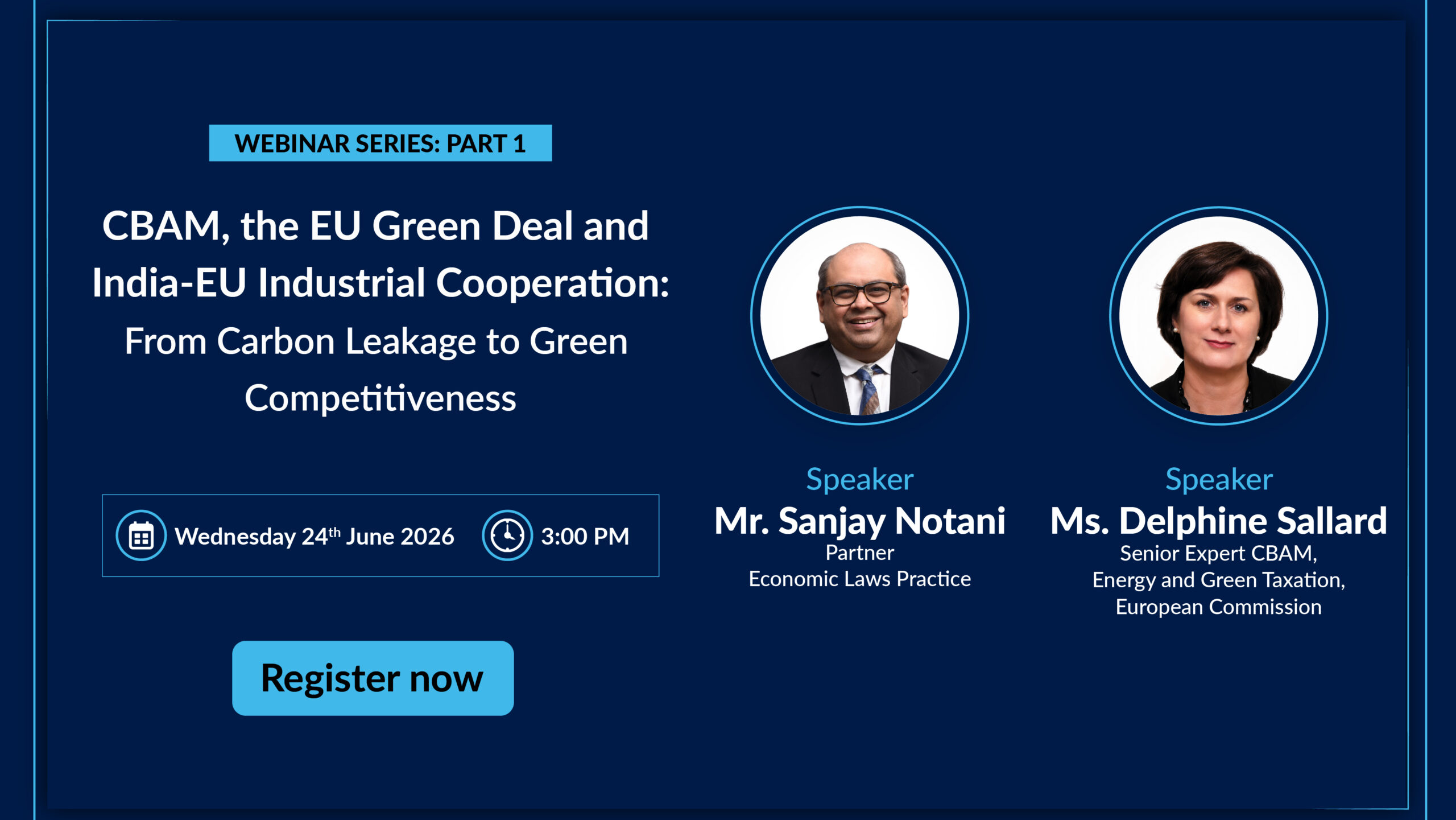
Economic Laws Practice (ELP) is pleased to invite you to the first webinar in its dedicated CBAM webinar series, examining the evolving legal, trade and industrial policy landscape shaped by the European Union’s Carbon Border Adjustment Mechanism, the EU Green Deal, and the emerging India-EU cooperation framework.

As CBAM moves from policy design to commercial impact, Indian industry must assess not only compliance exposure but also the broader strategic implications for market access, supply-chain competitiveness, decarbonisation investment and institutional engagement with the EU. This session will bring together legal, policy and industry perspectives to examine how Indian exporters and manufacturers can respond to CBAM as a catalyst for green competitiveness.

Agenda

  • India-EU Trade and Industrial Policy Implications
    • How CBAM affects Indian exporters, even though the formal obligation rests with EU importers or authorised CBAM declarants.
    • The potential role of the India-EU FTA in promoting investment in decarbonisation of Indian steel and aluminium industries.
  • Options for EU-India Cooperation on Green Industrialisation
    • Technology transfer, concessional finance, and climate-aligned investment.
    • Standards, mutual recognition, measurement methodologies and capacity building.
    • Opportunities for cooperation in the green hydrogen value chain.
  • Institutional Engagement for Effective Collaboration
    • Practical approaches to structured engagement among government, regulators, industry, exporters, financiers and technical experts.
    • Building channels for dialogue that support commercially viable and policy-aligned decarbonisation pathways.

Why This Webinar Matters

  • Understand CBAM beyond compliance: Assess how CBAM will influence contracts, pricing, procurement expectations, emissions data obligations and long-term competitiveness.
  • Prepare for India-EU policy convergence: Examine how trade negotiations, sustainability standards and industrial policy may shape future obligations and opportunities.
  • Identify decarbonisation pathways: Explore practical mechanisms for investment, technology adoption and finance in emissions-intensive sectors.
  • Engage strategically: Consider how Indian businesses and institutions can participate more effectively in EU-facing policy, regulatory and commercial discussions.

What participants can expect to learn from our CBAM Webinar Series

  • Unpack CBAM in the wider EU Green Deal and India-EU industrial policy context.
  • Identify how CBAM restructures obligations, contracts, and risk between EU importers and Indian suppliers.
  • Learn how emissions numbers, reporting and verification shape pricing, liability and market access.
  • Develop a structured strategic response for Indian metals and downstream sectors facing CBAM.

Who Should Attend

  • Exporters and manufacturers supplying to the EU market, particularly in steel, and aluminium sectors.
  • Exporters and manufacturers of downstream industries that may be covered under CBAM from 2028 like cast articles of iron and steel, automotive components, and appliances.
  • Legal, tax, trade compliance and sustainability teams.
  • Industry associations, chambers of commerce and policy professionals.
  • Financial institutions, investors and businesses evaluating green industrial projects.
  • Procurement, supply-chain and ESG professionals managing EU-linked value chains.

Privacy Policy

As per the rules of the Bar Council of India, lawyers and law firms are not permitted to solicit work or advertise. By clicking on the "I Agree" button, you acknowledge and confirm that you are seeking information relating to Economic Laws Practice (ELP) of your own accord and there has been no advertisement, personal communication, solicitation, invitation or any other inducement of any sort whatsoever by or on behalf of ELP or any of its members to solicit any work through this website.